Welcome to the Lattice Boltzmann Research Group
The Lattice Boltzmann Research Group (LBRG) is an interdisciplinary research group that aims to take advantage of novel mathematical modeling strategies and numerical methods to enable large-scale simulations and optimal control of fluid flows for applications in process engineering. The LBRG aims at a better fundamental understanding of suspensions in general and for the improvement of mechanical processes and medical treatments. In particular the LBRG designs and uses models, algorithms, and open source simulation tools such as OpenLB, always taking advantage of modern high performance computers for the simulation of, for example:
- Particulate fluid flows
-
Thermal flows
-
Turbulent flows
-
Material transport and chemical reactive flows
-
Light transport
-
Fluid-structure interaction
-
Flows in porous media and complex geometries
The LBRG’s teaching and education concept is project- and research-oriented, offering for example basic programming courses, lectures on parallel computing, software tutorials, and advanced seminars on particular fluid flow simulations as well as optimal control theory.
Read more:
Latest News

From 13 to 14 October, the Lattice Boltzmann Research Group (LBRG) at Karlsruher Institut für Technologie (KIT) welcomed researchers from Germany and Switzerland for the 1st Gitter Boltzmann Arbeitskreis (GBA) at KIT. In total, we had 36 participants and 18 talks on various LBM-related topics:
- Method Development
- Solid Mechanics
- Multiphase and Particle-Laden Flows
- Aeroacoustics and Compressible Flows
- High-Performance Computing and Software
Besides the talks, there was plenty of room for exchange: an open discussion on challenges, opportunities and joint activities, the conference dinner at Il Caminetto, and a closing session where we already looked ahead to the next meeting.
The GBA aims to build a national network for lattice Boltzmann research, teaching and innovation, bringing together method developers and users from research and industry, beginners and experts alike.
A big thank you to all session chairs (Jens Harting, Martin Geier, Stephan Simonis, Adrian Kummerländer, Fedor Bukreev), speakers and participants for making the first edition such a lively and productive meeting! We look forward to seeing you, and hopefully many new faces, at the next GBA in Braunschweig next year.
More info may be found here.

From 30 September to 1 October, the Lattice Boltzmann Research Group (LBRG) at Karlsruher Institut fur Technologie (KIT) took part in the 2nd International Conference on Lattice Boltzmann for Wind Energy and Atmospheric Flows (LB Wind 2026), hosted by IFP Energies nouvelles in Rueil-Malmaison near Paris.
We contributed two talks on our recent simulations of wind turbines with OpenLB, including compressible flows:
- Compressible Wall-Modeled Large Eddy Simulation of Wind Turbines Using Homogenized Lattice Boltzmann Methods in OpenLB - Fedor Bukreev et al.
- Rotors, Wakes, and Wind Farms: Large-Scale Platform-Transparent Simulations in OpenLB - Adrian Kummerlander
From compressible flows around individual rotors to entire wind farms, these talks show how lattice Boltzmann methods combined with high-performance, platform-transparent computing can enable high-fidelity simulations of complex atmospheric flows at scale.
Many thanks to IFP Energies nouvelles and Uppsala University for organizing such a great event.
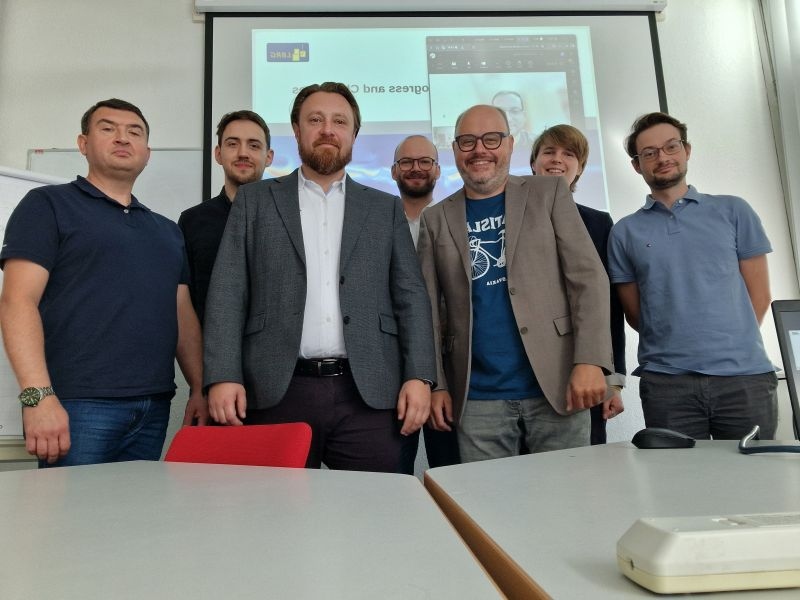
The Lattice Boltzmann Research Group (LBRG) at Karlsruher Institut für Technologie (KIT) met with our partners from AGH University of Krakow to discuss recent progress in high-Reynolds-number multiphase flow.
The scientific goal is to enable high Reynolds atomising jet simulations in LBM and FVM and gain a thorough understanding of how a liquid jet breaks up as it exits a subcritical nozzle.
A big thank you to our colleagues from AGH for a productive meeting and a great atmosphere. We're looking forward to continuing our joint research!